Making Trestle Bent Jigs
I've ripped the slats into scale 6x12s (actual ¼"x½") and the piles into scale 12x12s (actual ½"x½") using the table saw and some home made plywood push shoes to do it safely. The thicker slats I cut into scale 8x18s for the trestle stringers. I even made scale bridge ties to place across the assembled stringers, but I'm getting ahead of myself. I started by making a jig to both cut and assemble the scale 12x12s into trestle bents a scale 40' and 60' tall (actual 20" and 30", respectively). I "expand" my "shop" into the living room, for both assembling and experimenting, and we have the makings of a regular lumber mill, right here in scale.
Working in the living room allows me to experiment with different approaches to making trestle bents, combining the parts I like, and avoiding the ones I don't. And I can do it all from the comfort of my recliner while kicking back and relaxing in the evenings. The shortcomings of my template design and assembly technique soon become all too apparent. I rushed into making the original trestle bent template, using pieces I had on hand to allow me to quickly screw together something that would work. And something is better than nothing, believe me, but... Parts from one side that should be interchangeable with the other side weren't, and the screws that held the "guides" to the plywood base were barely long enough to hold them, so there was a lot of flex when cutting or assembling.
It was good enough to help me put together an assembly routine, holding the pieces together and in place while I hand drilled and glued together our first trestle bents. Each cross brace was laid in place and cut to fit by hand. Then the bent was removed from the template and flipped over to attach the cross bracing to the other side. Next I needed a way to assemble multiple bents together into an actual trestle, complete with "girts" and outside cross bracing. I used the dado cutter on the saw to make notches of the proper size in some of the stringer material, at the appropriate intervals to hold the sills together at the bottom and the caps together at the top, three bents at a time.
Making Trestle Bents
This worked well enough to put together a trestle approach, but now I would need scale sized stringers that were put together like the prototype, using through bolts and spacer "washers". I bought the smallest brass bolts and nuts I could find at Lowe's, but they were way too big, both scale wise and practical wise. I would need something much smaller. I looked at McMasterCarr to see what they had available, and found they didn't have much in the way of small brass hardware. I did order some lengths of #2 threaded brass rod that I would need for the tension rods for the bridge though. I found all the rest of the brass hardware I needed on eBay, as well as a brand new set of #2 dies to chase the threads when I cut the threaded rod.
I cut the stringer stock to scale 16' and 32' lengths (8" and 16", respectively) then hand drilled the ends for the through bolts. The method I used to cut the threaded rod to size for the bolts was rather involved, using two of the thread chasing dies, one on either side of the cut I needed to make. Once cut, I could chase threads on both ends, then move the dies to the next cut and repeat. It took forever to cut one 3' length of rod into pieces the size I needed for assembling the stringers. And because I hand drilled the holes, alignment was terrible too, which just added to the assembly time and frustration.
And frustrating it was! The stringers are bolted together three wide, with the ends staggered by a scale 16', and washers in between each section. I start by threading nuts on each of the 8 rods I need for every 8" of stringer, then add a washer for every nuts, and push them through from the back of the first section. Then I place two more washers on top of the rods protruding through that section in preparation for adding the next sections. Note that I said sections, not section, since I need to stagger the next "layer" by half length. One 8" section for a nice even end, then another 16" section hanging over the end of the first by another 8". With all those rods and nuts and washers in place, the last section can go on top, completing the assembly.
Making Bridge Jigs
I made another jig for assembling a howe deck truss bridge using the same "rickety" style as the tresle bent jig, except this time I added "threaded pins" like the kind they use to hold together that cheap "pressboard" furniture, e.g. Sauder. I'm hoping the pins will keep everything aligned so I can again hand drill and assemble a bridge truss. I quickly realize it suffers from the same issues as the trestle bent template did, plus it seems nearly impossible to get the holes for the pins drilled straight and in the correct position. I make the best of it and test the modular approach to assembling a bridge truss.
I "borrowed" the idea from an online kit form of these bridges. Basically, staggered "ends" are constructed with the idea that they can be overlayed onto each other such that the minimal length bridge is constructed. An "arbitrary" length center section is constructed using the same staggered pattern, and the pieces are brought together and assembled into a bridge of any length desired. I say arbitrary and any length, but the length limit is basically a multiple of the distance between diagonals, with the minimum being six times that distance between the diagonals and the maximum limited only by "realism". Too long and it looks "rickety". Too short and it looks too "stocky".
I made a jig out of ¾" plywood for assembling a howe through truss bridge using my router and carefully carving grooves for the various pieces to fit in. I draw everything out on the plywood first, then clamp a guide for the router, then plunge and remove just what needs removed. The long channels at the top and bottom I make 3⁄8" deep and the diagonals 1⁄8" deep. This will allow the top and bottom beams to lay flat and the diagonals to lay flat on top of them and align with them correctly. Sounds good anyway. Not sure how I manage to screw it up by cutting one of the long channels on the wrong side of the guide line though and have to make another pass to put the channel in the correct place right next to it.
Making Bridges
I made another jig for cutting and assembling a howe deck truss bridge using the same using the same approach as the through truss, but this time I mark the channels too, not just the guidelines. No mistakes this time. I get it routed correctly and drill holes where the threaded rods will go. I still have to hand drill the bridge members for them, but at least everything lines up correctly. I knock out the first truss in a few days. I need to cut some more threaded rod for the second, so it takes a bit longer. Within a few weeks I'm able to put together a howe deck truss bridge, suitable for display purposes anyway. It still needs stained and I'm not sure it's actually correct to prototype since all the pictures of a howe deck truss bridge that I've seen show the ends as diagonals with a straight pile to the caps, not connected to the rest of the bridge via the top beams, just there to support the stringers above. Looks good though...
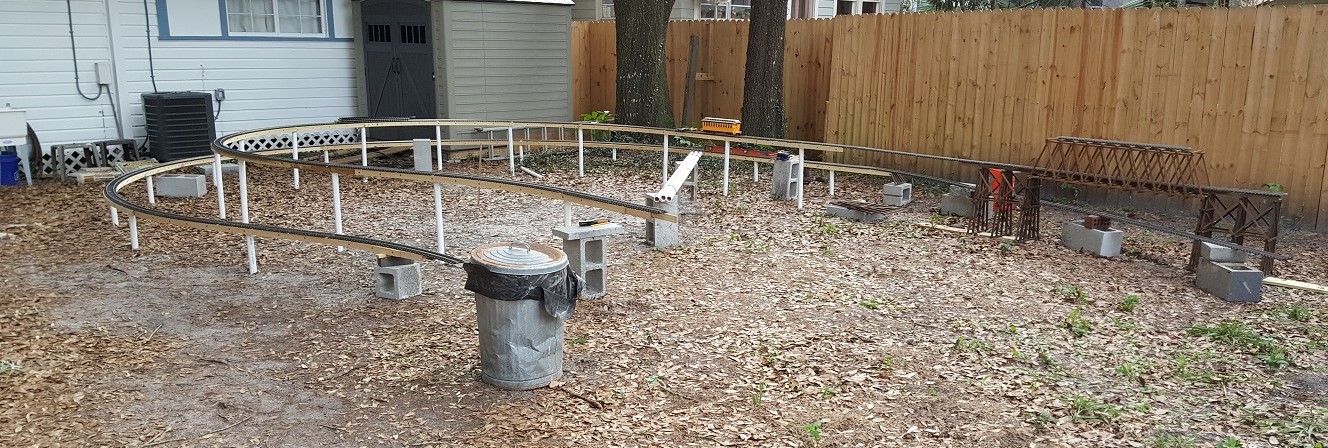
So now that I have a scale 48' (actual 24") long deck bridge, I can see that if I make it much longer, it will definitely look out of proportion. Time for a much longer (and much taller) howe through truss bridge. If I'm going to span that water feature with it that is. I start hand drilling the beam pieces, again with the staggered modular approach in mind. The deck truss was fairly rigid and did pretty well using the modular approach. The through truss is much larger, but still uses the same sized members, so it is far less rigid and much more prone to moving where it shouldn't. I manage to get a short truss together, enough for proof of concept and testing out the new jig.
As I assemble the longer 4' version of it, the problem becomes keeping it together without the beams wanting to come apart, especially where the staggered joints overlap. Tightening the nuts helps some, but I end up having to use larger washers over the outside joints in the beam to keep them from pushing apart as I tighten them. It works enough to get the first truss together, but I decide I need to just use one long piece in between the more prototypical sections that will be seen on the outside. This not only helps rigidity tremendously, but also eases assembly greatly, providing the "backbone" the structure needs.